Mamie “Peanut” Johnson

By Michael LeCompte

Mamie Johnson was one of only three women to play in the Negro League and was the only one to pitch.

Born in South Carolina in 1935 Johnson began playing baseball at the age of seven. After her family moved to Washington, D.C. she continued playing baseball whenever she could. When she was 17 Johnson tried out for teams in the All-American Girls Professional Baseball League (subject of the popular movie A League of Their Own). However, she was not seriously considered for a roster spot as teams subtly let her know that they were a league for white women only.

Seemingly rejected from organized baseball Johnson enrolled at New York University. During a visit home to Washington, D.C. in 1952, though, she was playing ball at a park when a retired Negro League player noticed her skill and got her a tryout with the Indianapolis Clowns. Johnson made the Clowns’ starting rotation in 1953 and signed a $500 a month contract. After one of the first batters she faced yelled “how do you expect to strike me out, you’re no bigger than a peanut” in reference to her diminutive size, the nickname “Peanut” stuck.

Although she stood only 5’3” tall and weighed only 100 pounds, Johnson was dominant on the mound, possessing a devastating curve ball.

It was rumored that the legendary Satchel Paige himself had taught Johnson how to throw a curve. According to Johnson, though, “he didn’t teach me how to throw it, he just taught me how to perfect the one I had.”

Over three seasons with the Clowns Johnson compiled a 33-8 record and also hit a respectable .273. She retired after the 1955 season so she could spend more time with her son and worked as a nurse for the next 30 years.

Looking back on her baseball career Johnson recounts that “if I had played with white girls, I would have been just another player, but now I am somebody who has done something that no other woman has done.”

Last summer Johnson was in attendance at the Little League World Series to watch Mo’ne Davis, a 13 year old African-American, do something no girl had ever done before by pitching a shutout.

After the game the only woman to ever pitch in the Negro League said of Davis, “this girl’s the best thing since food.”

Today Johnson is part of a commission trying to revive baseball among the youth in African-American communities of Washington, D.C. The field where she played growing up has been named “Mamie Peanut Johnson Field at Rosedale Recreation Center,” and she is personally involved with recruiting children to play and forming city leagues and teams. Now 79, she has “decided that before I go, I am going to see people like me playing baseball again.”

Mamie “Peanut” Johnson, the only woman to pitch in the Negro League, ensuring that her legacy lives on by providing the opportunity for kids to play the game they love.
The Harlem Globetrotters

By Michael LeCompte

We’ve probably all seen them at some point in our lives. They’re instantly recognizable by their red, white, and blue uniforms and “Sweet Georgia Brown” theme song, but exactly how did the Harlem Globetrotters become both an athletic and African-American cultural institution?

Now known as “The Original Harlem Globetrotters” the team was actually born on the South Side of Chicago in the roaring ’20’s to help promote the Savoy Ballroom.

In 1926 Abe Saperstein, a 24 year old Jewish man from London organized a team of local players he dubbed the “Savoy Big Five” to put on exhibitions before dances at the Savoy.

Saperstein made the team’s first uniforms himself (his father was a tailor and had imparted his son with the necessary skills).

In 1928 Saperstein renamed his team the “Globe Trotters” before embarking on a promotional tour of southern Illinois. A year later the team assumed the name “New York Harlem Globe Trotters” as Harlem was by then considered the center of African-American culture in the country.

Originally the Globetrotter’s exhibitions consisted of games against local teams or dribbling and shooting showcases. However, with the rise of semi-pro and ultimately professional basketball in 1946, they could no longer attract or keep the talent necessary to compete on a serious level. As a result Saperstein introduced an element of trickery into his team’s games and the Globetrotters became the entertainment spectacle that we know today.

By the 1950’s the team was living up to its name, holding exhibitions around the world. In 1959 they even travelled to Moscow and played against a Russian National team with Nikita Khrushchev in attendance.

Throughout their history the Globetrotters have primarily played the Washington Generals, a team founded by Red Klotz at he behest of Saperstein to travel with his Globetrotters. Since 1952 the Generals have willingly played the stooge to the trickery of the Globetrotters.

Many talented basketball players have suited up for the Globetrotters. Wilt Chamberlain played for them before joining the NBA and former players, such as Darryl Dawkins, have also found a second life on the court with the team. Every year the Globetrotters hold a draft, mostly in jest, and choose the athletes they want, even if they aren’t basketball players and will never suit up for the team.

Prominent African-Americans such as Magic Johnson and Bill Cosby have been signed to $1 a year lifetime contracts by the Globetrotters.

During the Civil Rights era the Globetrotters were often criticized for not taking themselves seriously enough. Activists felt that the team was reinforcing negative stereotypes by pandering to a white audience in the name of entertainment.

Since 1926 the Globetrotters have held over 20,000 exhibitions in 120 countries, counting among their honorary members the likes of Nelson Mandela and Pope John Paul II.

The Harlem Globetrotters are a distinctly American story. A team of African-American athletes founded in Chicago by a Jewish businessman, named for Harlem and based in Phoenix, Arizona, they have managed to transcend race and world politics with their unique blend of sport and entertainment.

Isaac Murphy: The Best Jockey Ever Forgotten

By Michael LeCompte

Despite their exclusion from professional leagues there were two athletic avenues where African-Americans excelled in the late nineteenth century and for the first half of the twentieth century, boxing and horse racing.

African-American fighters and jockeys were undeniably talented, but their inroads in these sports was also due to the fact that rich white men of the time could make money off of them. Boxing promoters and trainers, as well as horse owners, could make money with a single African-American athlete without alienating the rest of a team or an entire league, as in other professional sports.

In the post-bellum South few African-Americans could afford to own race horses, but a talented jockey could certainly have an impact on the “sport of kings.” Thirteen of the fifteen jockeys in the first Kentucky Derby were African-American and of the first twenty-eight runnings of the Derby, fifteen of the winning jockeys were African-American.

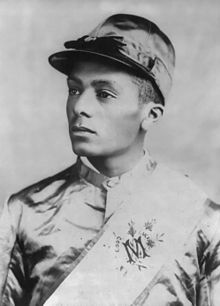
Isaac Murphy, the most dominant jockey of the era was born on April 16, 1861, four days after the Civil War started, in Frankfort, Kentucky. His father, a free black man, joined the Union Army and was eventually captured and held as a prisoner of war at Camp Nelson.

Upon receiving word of his father’s death in 1863, Isaac and his mother moved to Lexington, Kentucky, where she worked at the racing stables.

At age fourteen a horse trainer, noting Murphy’s small stature, taught him to ride. After some immediate success in small, local races Murphy devoted himself to the sport. Although somewhat unorthodox at the time, Murphy found he got better results out of his mounts by urging them on with words and his spurs, rather than with the whip.

220px-IsaacMurphy

Soon Murphy was earning $10,000-$20,000 a year as a jockey, enough to afford a large estate and his own stable of race horses. He won the Kentucky Derby in 1884, 1890, and 1891. In 1,412 career mounts he garnered 628 wins for a winning percentage of 44% (still the highest ever).

Unfortunately by 1895 his weight and rampant alcoholism caught up with Murphy and he was suspended for racing while inebriated and ultimately chose to retire. He died a year later in 1896.

Through his on-track exploits Isaac Murphy, an African-American, was able to carve a place for himself within a society dominated by the White population. He rode his way to fortune, fame, and a place in history as one of the greatest jockeys ever.

Toni Stone: The First Woman In The Negro League

By Michael LeCompte

Toni Stone was the first of three women to play in the Negro Leagues. For this self- described tomboy from Minnesota baseball was a life-long love affair. She started playing organized baseball when she was ten on Catholic Midget Leagues in St. Paul. By age fifteen she was playing alongside men for the St. Paul Giants, a semi-professional team.

After marrying a man forty years her senior, Stone moved around the country playing for different teams in several leagues, always looking for the best opportunity to get on the field.

When she was twenty-eight Stone’s professional career began in earnest when she joined the San Francisco Sea Lions to play second base for the 1949 season.

After one season in San Francisco she played for the New Orleans Creoles until 1952.

Stone’s big break came the next year when the Indianapolis Clowns offered her a contract to replace a young Hank Aaron, who was departing for Milwaukee.

The Clowns joined the Negro American League in 1943 and were known for their unique on-field mix of show business and baseball. Considered the Harlem Globetrotters of baseball the Clowns’ act lasted until 1989.

Initially the Clowns signed the thirty-two year old Stone as a publicity stunt. They claimed she was ten years younger than she actually was and that she’d earned a graduate degree but would rather play baseball than do anything else, and they reported that she was paid $12,000 a year. (Stone later said her contract was “greatly exaggerated” and indeed it was probably $500 a year or less)

Regardless of any exaggeration and fabrication, or of the Clowns’ on-field antics, though, members of the team still had to be able to play the game. Over her one season in Indianapolis Stone hit at a respectable .243 clip and even managed to get a hit off the legendary Satchell Paige.

Stone was traded to the Kansas City Monarchs in 1954, but retired 50 games into the season due to a lack of playing time, an issue that dogged her throughout her career as managers were more apt to let male players, white or black, take the field instead of her.

In retirement Stone worked as a nurse and cared for her aged husband, while continuing to be an ambassador for the game she loved. She was elected to the Women’s Sports Hall of Fame in 1993.

Stone passed away at the age of seventy-five in 1996.

This pioneering woman of the Negro League is remembered every March 6th when St. Paul, Minnesota celebrates “Toni Stone Day.”

Rushing Into History: Fritz Pollard, The First Black Professional Football Player

By Michael LeCompte

Any sports fan and even most school children know who the first black player in baseball was. However, Fritz Pollard, the first black man to play professional football, has largely been forgotten.

Frederick Douglas Pollard was born in a German neighborhood of Chicago (hence the nickname Fritz) in 1894. The son of a black man and a Native-American woman, the Ivy-League educated Pollard would go on to become the first black player, then coach in the NFL, as well as the inspiration for a Mickey Mouse cartoon.

fritzpollard

Although he was only 5’9″ and 165 pounds Pollard played running back and led Brown to the 1916 Rose Bowl against Washington State.

It rained for several days prior to the game and the field was a muddy mess. Brown lacked adequate cleats for the conditions and Washington State’s line, which was an average of 13 pounds heavier per man than Brown’s dominated in the 14-0 Washington State win.

The Brown players later claimed that several of Washington State’s linemen were not students and that others had been on the team between 5 and 8 years because they were only enrolled during football season.

After a play late in the game where several Washington State players held Pollard face down in a mud puddle after tackling him the Brown coach pulled him from the game.

Pollard’s sideline protestations to be allowed back in the game supposedly attracted the attention of Walt Disney in the Rose Bowl crowd. According to Pollard’s own account “the sight of me jumping up and down from the bench had never left his mind. Years later he used the scene in a Mickey Mouse cartoon. It’s the one in which Mickey’s team plays these big lions and Mickey keeps popping up from the bench…”

In 1920 Pollard led the Akron Professionals to an 8-0-3 record and the first ever NFL championship. Due to his small stature and the racial aggression of the time he was often targeted by opposing teams. Pollard took the unnecessary roughness in stride, explaining that “he wouldn’t get mad at them and want to fight,” but rather that he would “just look at them and grin and in the next minute run for an 80 yard touchdown.”

In 1921 Pollard became the first black coach in the history of the NFL when he agreed to lead his Akron Professionals.

However, his professional success was short-lived when Pollard and the nine other African-Americans in the NFL by that time were forced out of the league following the 1926 season, due to a racist gentlemen’s agreement among the league’s owners.

There would not be another African-American in the NFL until 1946.

Fritz Pollard died in 1986 and was posthumously elected to the Pro Football Hall of Fame in 2005, where he was described as having “the speed of Tony Dorsett, the elusiveness of Barry Sanders, and the tenacity of Walter Payton.”

Perhaps more importantly, though, as the first African-American in professional football Fritz Pollard made the careers of those three men and of countless others possible.

Sources:
Carroll, John. Fritz Pollard: Pioneer in Racial Achievement. University of Illinois, 1998.
http://www.nfl.com
http://www.profootballhof.com

Larry Doby: The Second Player Across Baseball’s Color Line

By Michael LeCompte

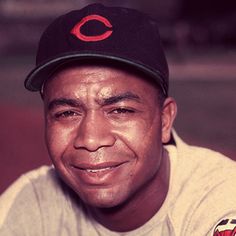
A sometimes unfortunate aspect of history is that the second person to do something is often forgotten. Eleven weeks after Jackie Robinson broke the color barrier in Major League baseball, Larry Doby joined the Cleveland Indians.

Although largely overlooked in 1947 as the national media followed the trials and feats of Robinson with the Dodgers in the National League, Doby was the first black player in the American League.

Larry Doby was born in Camden, South Carolina in 1923 and grew up in New Jersey. Like Robinson, Doby was also a three sport star in high school. According to teammates and coaches he had professional level talent in football and baseball.

However, Doby initially harbored professional aspirations of a different kind. Hoping to follow the example of an influential high school coach, he planned to go to college, with the ultimate goal of becoming a P.E. teacher.

His prowess on the baseball diamond, though, got him noticed by a gentleman in his neighborhood who happened to serve as a Negro League umpire. In 1942 the umpire managed to get him a tryout with the Newark Eagles. Doby made the team and played in Newark for four seasons, winning one Negro League Championship.

In 1947 Bill Veeck, the owner of the Cleveland Indians and originator of the outlandish sports promotion, signed Doby. The signing was no joke, though, and coming eleven weeks after Robinson’s debut, showed the league that the color barrier was indeed broken forever.

larrydoby

Over a thirteen year Major League career Doby hit .283 with 253 homers. In 1,553 games he had 1,515 hits. He was a  seven time all-star and the first man to play in both the Negro League Championship and the World Series (where he became the first black player to homer in a World Series game).

Although he endured many of the same racial slurs and slants as Robinson and despite a Hall of Fame career, Doby was often overlooked. As his Indians teammate Bob Feller once remarked, “he was kind of like Buzz Aldrin, the second man on the moon, because he was the second African-American in the majors behind Jackie Robinson.”

In 1978 Doby became just the second black manager in Major League history when Bill Veeck, the man who had brought him into the league as a player, hired him to manage the Chicago White Sox.

Unfortunately Veeck would end up firing him before the end of his first full season as manager and Doby never got another opportunity to coach at the big league level. Doby served in various executive and ambassador positions in baseball until his death in 2003.

Larry Doby, the second African-American in the Major Leagues and a first rate talent.

Andrew “Rube” Foster: “The Father of Black Baseball”

By Michael LeCompte

In honor of black history month theolballgame will highlight the lives and careers of influential and pioneering black athletes.

Jackie Robinson broke the color barrier in Major League baseball in 1947. The Robinson story is well documented and remembered, and rightly so, however, for decades prior to his breaking into the game, African-American players were relegated to the rosters of town teams, independent leagues, and the Negro League.

It was the formation of the Negro League by Andrew Foster and the success of its players, against other black teams, as well as against all-star squads of white major leaguers, that ultimately led to integration. As John Holway argues in his book Voices of the Great Black Baseball Leagues, “without Rube Foster’s historic achievement, it is fair to say, black baseball might not have survived for another quarter century, and the nation might never have heard of Jackie Robinson.”

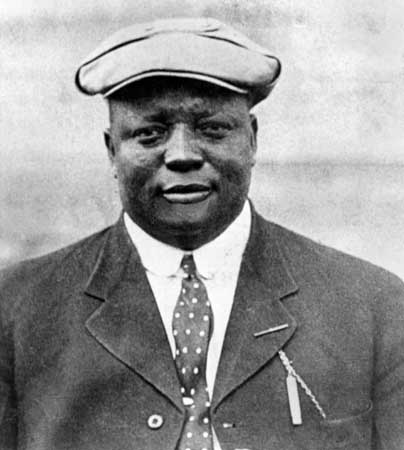
Andrew “Rube” Foster was born in Texas in 1879. He quit school after the eighth grade to try and earn a living playing baseball.

As he grew to be 6’2” and 200 pounds Foster bounced around between several independent teams in Texas and on the East coast. In 1905 he caught on with the Cuban X-Giants, one of the top black teams in the country.

Foster was a dominating power pitcher and compiled an astonishing 51-4 record in 1905. (However, statistics were not kept or compiled as meticulously in 1905 as they are now, especially concerning black teams, and some recent research suggests Foster’s 1905 record may have been a somewhat more modest 23-5).

National Baseball Hall of Fame Library Archive

By 1910 Foster was playing for the Leland Giants in Chicago. That year the Giants went 123-6 and in the off-season Foster partnered with John Schorling, the son-in-law of Charles Comiskey, to buy the team. They renamed the team the American Giants and Foster agreed to manage them.

In 1911 the White Sox moved into Comiskey Park and the American Giants moved into the now vacant South Side Stadium. As owner, Foster insisted on a high level of professionalism from his team, he set strict rules concerning both personal conduct and appearance.

As manager, partly due to his team’s new spacious park Foster promoted a style of play based on the fundamentals of the game. Power pitching and defense were hallmarks of his teams, as was the ability to bunt, and speed on the base paths.

In 1920 Foster founded the Negro National League and six other clubs throughout the Midwest joined in. Formation of the league legitimized black baseball. Member clubs now had a more concrete schedule and at least the possibility of larger gate receipts and steady pay. The Negro Southern and Eastern Leagues were created soon after.

Foster’s American Giants won the first three pennants of the Negro National League. Despite the success of the team he owned and managed, the fledgling league continued to be beset by economic woes. Foster was known to wire money out of his own pocket to rival teams to help them meet payroll. He also frequently traded his own players to keep a competitive balance in the league.

In 1926 Foster suffered a mental breakdown, perhaps as the result of prolonged exposure to a gas leak, and was admitted to an asylum in Kankakee, Illinois. He died in 1930.

Considered “The Father of Black Baseball” Andrew “Rube” Foster had an impact on the game as a player, manager, executive, and pioneer. He was elected to the Baseball Hall of Fame in 1981.

Sources:
Holway, John. Voices From the Great Black Baseball Leagues. Dodd, Mead and Company: New York, 1975.
http://www.baseballreference.com
http://www.baseballlibrary.com
http://www.thesocietyforamericanbaseballresearch.org

Epic Super Bowl Fails

By Michael LeCompte

Those good enough to make it to the NFL play for many reasons. A pure love of the game drives some, while the opportunity for fame and fortune drives others. Regardless of why they play, the point of the game is to win, the objective of every player on every team is to win the Super Bowl.

Players hope to win and take their place in history. They dream of Super Bowl glory, of making the winning play.

Of course the harsh reality of the NFL is that it is extremely hard to even make it to the Super Bowl, and even more difficult to win. For every long bomb pass and incredible run there are perhaps an equal number of disastrous plays, epic fails on the grandest of stages that go down in Super Bowl infamy, to be cringed at every year.

Here’s a look at perhaps the four biggest fails in Super Bowl history.

Super Bowl XIII. Jackie Smith

Over a Hall of Fame career with the Cardinals and Cowboys, tight end Jackie Smith caught 480 passes for 7,918 yards and 40 touchdowns. Unfortunately he is most remembered for a crucial dropped pass in the Super Bowl.

Pittsburgh Steelers v Dallas CowboysDallas trailed Pittsburgh 21-14 late in the third quarter when Smith inexplicably dropped a pass when he was wide open in the middle of the end zone. There wasn’t a Steeler within seven yards of him, but he dropped the ball and Dallas went on to lose the game 35-31.

Despite Verne Lundquist’s memorable “bless his heart he’s gotta be the sickest man in America” call of the drop, Smith had nothing to be ashamed of and in hindsight his drop seems natural.

After spending his entire career with the Cardinals Smith was 38 years old when he signed with Dallas in 1978. That season he was used primarily as a blocking tight end and didn’t catch a pass all season.

He retired before the start of the next season.

Super Bowl XXV. Scott Norwood

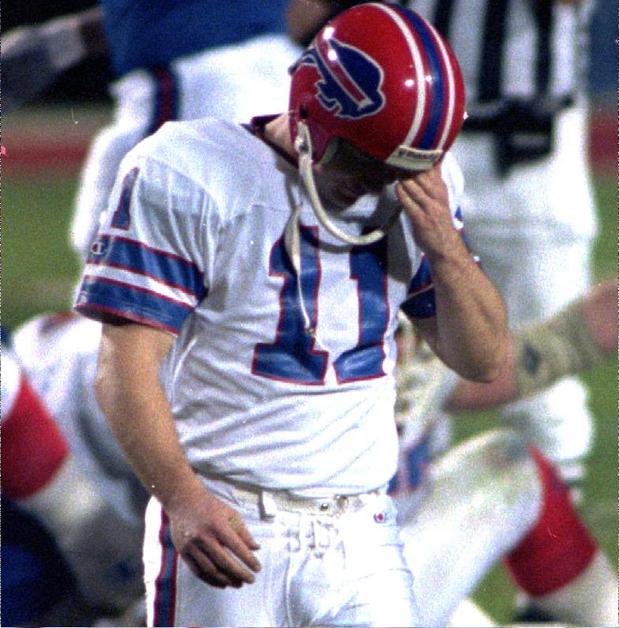
The Bills trailed the Giants 20-19 when Norwood lined up for  a 47 yard field goal with eight seconds left. His kick had the distance, but as Al Michaels exclaimed, sailed “WIDE RIGHT.”

widerightThe loss was the first of four consecutive in the Super Bowl for Buffalo and the one point defeat would turn out to be their best chance, as they were blown out in the next three.

Norwood was waived by the Bills following the 1991 season. He became an insurance salesman before going into real estate.

Super Bowl XXVII. Leon Lett

Lett was a defensive tackle from 1991-2001 and a member of the dominant Cowboys teams of the early nineties. In Super Bowl XXVII Dallas was blowing out Buffalo 52-17 when Lett recovered a fumble at the Cowboy’s 35 yard line with nothing but 65 yards of open field before him.

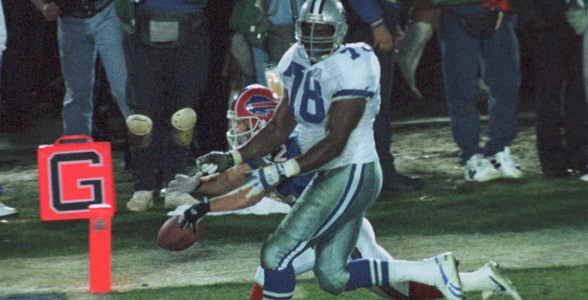
He rumbled down the field and it looked like he would score when he suddenly slowed down inside the ten yard line, held the ball out in front of him and began celebrating. Don Beebe of the Bills never gave up on the play and caught up with Lett, knocking the ball out of his hands and through the end zone for a touchback.

leonlettitgoAlthough Dallas went on to win 52-17 Lett became a national punch line and the career of “Leon Lett-it go” could serve as a cautionary tale for every young player, imparting valuable lessons such as don’t celebrate before you reach the end zone and don’t do drugs, for which he was suspended a total of 28 games throughout his career.

Lett is currently an assistant defensive line coach for the Cowboys.

Super Bowl VII. Garo Yepremian

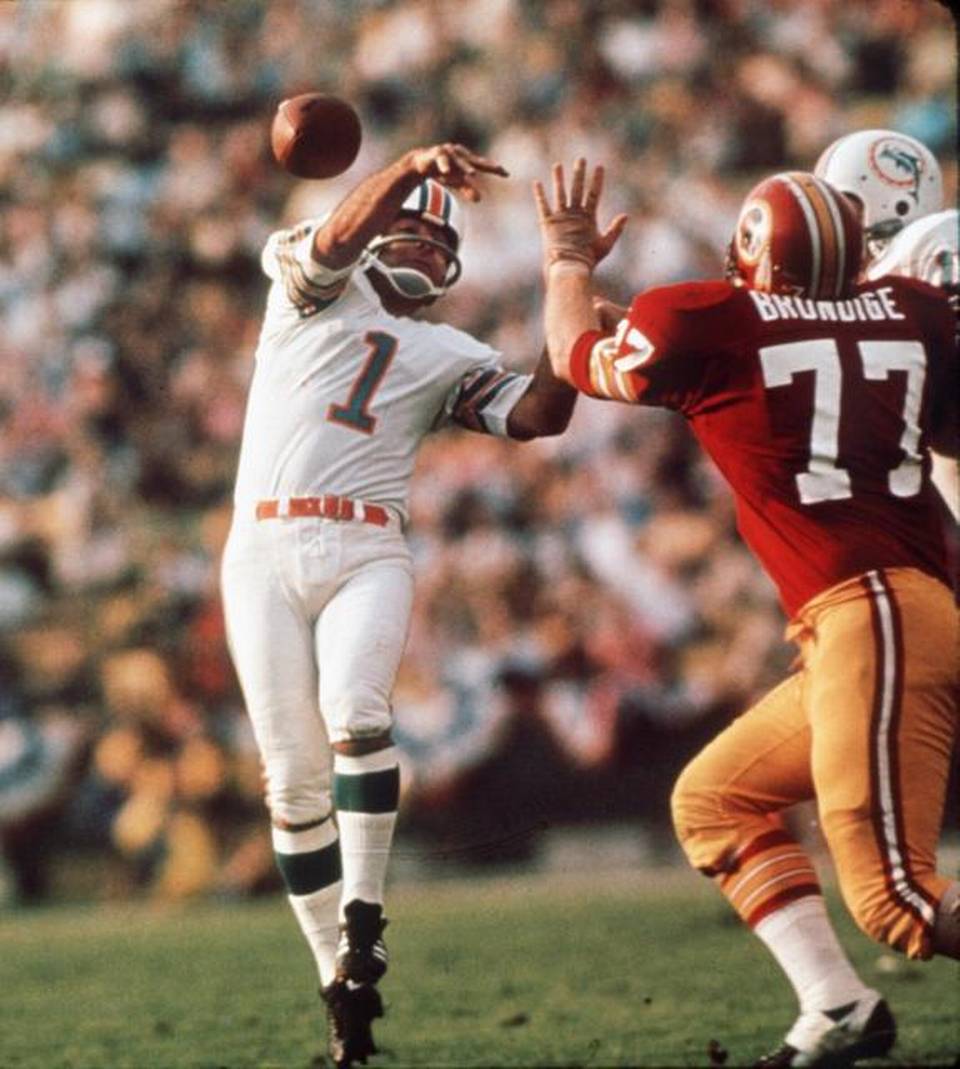
In Super Bowl VII the undefeated Dolphins were leading the Redskins 14-0 with just over two minutes left. Yepremian came in for a field goal that would put the game out of reach. The kick was blocked, but Yepremian picked it up and tried to throw it. In what may be the worst pass attempt in NFL history the ball simply popped/slipped straight up out of the 5′ 7” 160 pound Yepremian’s hand into the hands of Washington’s Mike Bass, who returned it for a touchdown.

garoyepremianFortunately for Yepremian the Dolphins hung on to win 14-7 and over a fifteen year career he made 210/313 field goals.

Following his playing career, the Cypress born Yepremian, who came to America with $10 in his pocket and whose first football game he ever saw was the first NFL game he kicked in, has worked as a motivational speaker.

He has also re-enacted his blocked kick and botched pass with Mike Bass for a Wounded Warrior Project fundraiser.

After his daughter-in-law died of brain cancer he founded the Garo Yepremian Foundation for Brain Tumor Research. In a cruel bit of irony, or perhaps just another unfortunate bounce of the ball in the game of life, Yepremian, now 70, has been battling adrenal cancer and a brain tumor himself.

Are these the four worst plays in Super Bowl history? Perhaps not, two of the players who made the biggest mistakes of their careers in the big game still managed to walk away with rings and all four moments are replayed every year in the buildup to the Super Bowl, these “goats” immortalized forever, right alongside the hero’s.


Minutemen Vs. The 12th Man

By Michael LeCompte

As Super Bowl XLIX approaches nearly every aspect of the Seahawks and Patriots matchup has been compared. The teams, coaches, players, fans, and cities have been analyzed and over-analyzed. In keeping with the pregame analysis of the absurd here’s a look at two essential elements of Patriot and Seahawk fandom, the End Zone Militia and the 12th Man.

While neither group is an official mascot, that distinction is reserved for Pat the Patriot and Blitz the Seahawk, each rabidly supports their team. The militia is a group dedicated to both history and football, and the 12’s are fiercely loyal to Seattle and provide a definite home field advantage.

The End Zone Militia

Every NFL team and stadium has its own traditions and whether you’re a Patriots fan or not you have to admit that the line of men dressed in Colonial era garb, holding rifles and lining the back of the end zones is pretty cool.

The End Zone Militia started in 1996 and consists of about forty members for each Patriots home game, with about twenty men behind each end zone.

bos_a_militia1x_300

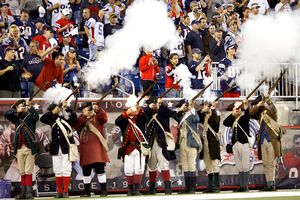
After every Patriots touchdown and successful extra point a Captain steps in front of the militia, raises his sword and yells, “MAKE READY. PRESENT. FIRE.” Then the sound of musket fire thunders through Gillette stadium.

To be a member of the militia one must be a Revolutionary War re-enactor in good standing with a re-enactor’s club or organization for at least three years. Members do not get paid and must buy their own costumes and powder muskets, which may run upwards of $3,000, depending on the desired level of authenticity. Militia members must also abstain from alcohol before and during games.

Although End Zone Militia members get free tickets to the game and get to be part of the sideline festivities, their group actually has no affiliation with the New England Patriots and they have not been entirely free of controversy throughout their history.

In 2003 Patriots kicker Adam Viniateri missed an extra point attempt due to lingering musket smoke after a touchdown and Chad Ochocinco once claimed that after he scored against the Patriots he would grab a musket and fire it. Fortunately by the time he made it into the end zone the Patriots were blowing out his Bengals and he chose not to celebrate.

The 12th Man

Of course the 12th Man is not on the field like the End Zone Militia, but is rather 68,000 strong throughout the stadium and also encompasses every Seahawk fan everywhere. As Seattle head coach Pete Carroll says, “the 12th man has an unparalleled impact on game day.”

That impact is heard, not only when Seattle scores, but throughout the game and it is felt at key moments when the 12’s quite literally make the earth move.

seattle-seahawks-12th-man-flag-flying-620x400

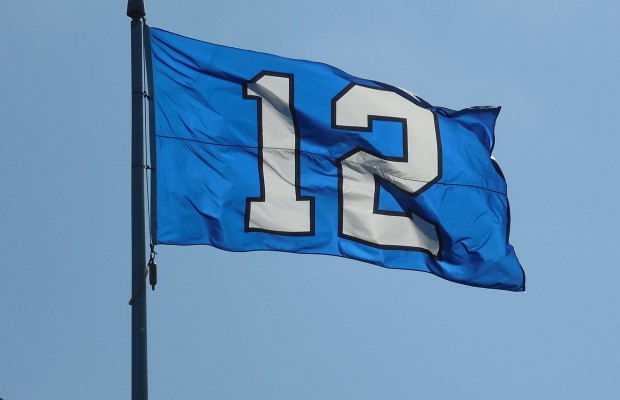
Seattle retired the number 12 in 1984 in honor of their fans and someone with connections to the team or region raises the 12th man flag before each game.

Like the End Zone Militia, the 12th Man has also been embroiled in a certain amount of controversy.

Texas A&M uses the term “12th Man” to refer to its entire student body, past and present. The University traces its ownership of the term back to 1922 when the football team was so depleted by injury that they called a student, E. King Gill, down from the stands to suit up. Gill never made it onto the field that day, but the legend was born.

In 2006 Texas A&M sued the Seahawks over ownership of the 12th Man. Eventually Seattle acknowledged the University’s ownership of the trademarked phrase and the two sides reached an agreement where Seattle could use the term under license.

Seattle paid Texas A&M a $100,000 lump sum and must pay $5,000 annually until 2016 when the deal can be renegotiated. To ensure that its trademark is being respected Texas A&M sends “undercover” fans to Seahawks games once a year.

The End Zone Militia and the 12th Man, two unique, yet passionate groups of fans. While there is a waiting list to join the militia, the 12’s are not limited to Century Link field and seem to be growing rather exponentially.

Everything else about the Patriots and Seahawks has been broken down and ranked favorably in one direction or the other, so here’s yet another prediction: as we saw last year the 12’s will travel.

This is the sixth Super Bowl appearance this century for the Patriots, it’s what their fans expect this time of year, while success is still semi-new and certainly still exciting for Seattle’s long suffering, yet loyal fan base.

When Super Bowl XLIX kicks off on Sunday, University of Phoenix stadium may become the new “Home of the 12th Man” a one game home away from home for the Seahawks.

Why Peyton Manning Should Retire

By Michael LeCompte

Athletes are notorious for staying in the game too long, for hanging on at least one season too many. Very few superstar athletes retire on their terms, usually the game dictates when they go.

Peyton Manning should retire.

Over the past 17 seasons he has become the best quarterback the NFL has ever known, as well as the face of the league. He is tops in every statistical category, including most touchdown passes (530).

He’s been so good for so long that we expect him to continue to perform at a high level, but when the end of an athletic career comes, it comes quickly. Seattle thoroughly dominated Manning in the Super Bowl and last Sunday the Colts made him look older than 38.

By all accounts Manning’s a classy guy who would never do anything to embarrass himself or the game of football, which is why he should retire now.

At times on Sunday Manning simply looked like a tired, frustrated, old man. He finished the game a respectable 26/46 for 211 yards and a score, but it was obvious he could no longer do what he wanted to and what we’ve all become accustomed to seeing him do. He couldn’t march the Broncos up and down the field seemingly at will, he couldn’t even hit his wide open receivers. As a result the Broncos lost to what is probably an inferior Colts team.

Manning should heed the example of another retired superstar, Brett Favre, the man whose records he broke.

Like Manning taking the Broncos to the Super Bowl last year, Favre was also able to conjure some late career magic. He took the Vikings to the NFC Championship in 2009 and was a few bounty-gate hits by the Saints away from the Super Bowl.

After coming so close Favre insisted on coming back the next year, but only played in 13 games and tossed 19 interceptions. Peyton came back this season and the Broncos were again a playoff team, but the Manning magic was clearly gone, especially in the postseason.

Although it often went unnoticed by broadcasters due to the NFL’s weird love affair with Manning, it seemed as though about half of his pass attempts this season were wobbly ducks, rather than tight spirals. Whether this stems from his multiple neck operations or was the result of him playing with a torn right quad muscle for the final month of the season, as ESPN reported, the end is painfully and obviously here for Manning.

Of course he has come back before. Overcoming four neck operations was no small feat and after all he’s accomplished over the past seventeen seasons, perhaps Manning has earned the right to say when he’s done.

Peyton Manning proved he was a champion by winning a Super Bowl, he showed his heart by working his way back from injury, and he became the greatest by re-writing the record books.

If he is concerned about his legacy, if he has any doubts about it at all, he need only look at the career of Ryan Leaf, the man drafted #2 behind him in 1998, who many thought should have been the #1 pick.

And if the cautionary tale of Favre weren’t enough, Manning should follow the shining example of another superstar from a different sport and retire now. Last summer, Derek Jeter provided a classy blueprint of how an aged, yet beloved player with a clearly declined skill set, could walk away from the game.

The Broncos could probably win their division again next year, however, another Super Bowl run with Manning at the helm is unrealistic. His play has already started to decline and if he comes back he will undoubtedly be hampered by nagging injuries.

Peyton Manning is the best quarterback to ever play football, which is why he should retire…NOW. He should retire while there is no question about who the greatest is. He should retire without generating any debate by coming back and becoming yet another athlete who stayed in the game too long.